


Molecular Devices SpectraMax M2e Multilabel Microplate Reader
Wavelength Range
200 to 1000 nm
Wavelength Selection
Monochromator, tunable in 1 nm increments
Wavelength Accuracy
± 2.0 nm
- Dual-mode functionality enables both absorbance and fluorescence intensity detection for versatile assay applications
- Top- and bottom-read modes enhance sensitivity for solution-based and cell-based assays
- PathCheck technology ensures consistent optical pathlength, improving data accuracy and reproducibility
- Supports multiple plate formats (6 to 384 wells), providing flexibility for various throughput needs
- Rapid read times for both absorbance and fluorescence modes accelerate workflows and boost productivity
- Built-in cuvette port allows seamless transition between low-throughput and high-throughput assays
- Robotics-compatible design enables easy integration into automated laboratory workflows
- Intuitive software interface simplifies assay setup and data analysis, streamlining the user experience

The SpectraMax M2e is a dual-monochromator, multi-detection
microplate reader with a dual-mode cuvette port and 96 or 384 microplate reading
capability. Detection modalities include absorbance (UV-Vis Abs) and
fluorescence intensity (FI) and have optical performance comparable to a
top-of-the-line dedicated spectrofluorometer or spectrophotometer. Endpoint,
kinetic, spectrum and area-well scanning read types and PathCheck allow
homogeneous and heterogeneous microplate assays to be performed in this
flexible system. The FI and Abs microplate reader with built-in cuvette port
allows easy conversion and optimization of very-low-throughput assays into
medium-high-throughput microplate assays.
The SpectraMax M2e allows faster, more precise results and reagent savings. In addition, combined absorbance and fluorescence intensity assays can be run by issuing a single read command. The M2e features top- and bottom-read modes, resulting in greater sensitivity for solution and cell-based assays. Within endpoint and kinetic measurement protocols, up to four wavelength pairs can be read at a time, allowing for improved efficiency for FRET assays. Key Features: dual mode cuvette port, robotics compatible, multilabel, dual monochromators, and PathCheck.
Applications include: DNA, RNA, and protein quantitation and purity; PicoGreen, NanoOrange, and Bradford; ELISAs and enzyme kinetics; drug dissolution profiles; live or dead viability or cytotoxicity assays; Caspase-3 and protease assays; cAMP assays using CatchPoint Assay Kits; and low volume applications.
All of our equipment is fully tested to perform at factory specifications before being shipped.
The Molecular Devices SpectraMax M2e Multilabel Microplate Reader includes:
- > Windows 10 Data Station Pre-Loaded with SoftMax Pro Software 7.1.2
- > Interface Cable
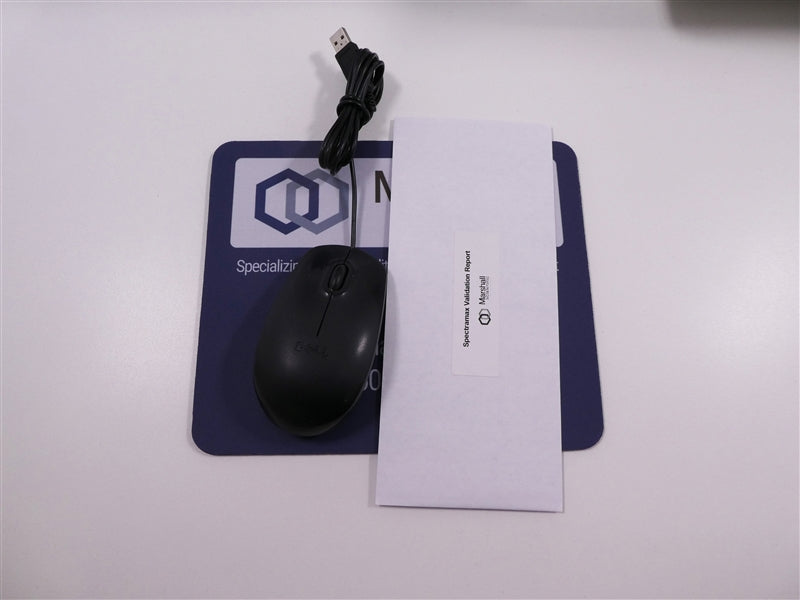
- > Molecular Devices Absorbance and Fluorescence Validation Report
- > Top Read Plate
- > Power Cord
- > Operator's Guide
- > Full 180 Day Parts and Labor Warranty
Molecular Devices SpectraMax M2e Multilabel Microplate Reader Specifications
|
Absorbance Photometric Performance |
|
|
Wavelength Selection |
Monochromator, tunable in 1 nm increments |
|
Wavelength Range |
200 to 1000 nm |
|
Wavelength Bandwidth |
≤ 4.0 nm |
|
Wavelength Accuracy |
± 2.0 nm |
|
Wavelength Repeatability |
± 0.2 nm |
|
Photometric Range |
0 to 4.0 OD |
|
Photometric Resolution |
0.001 OD |
|
Photometric Accuracy (Microplate) |
< ±0.006 OD ±1%, 0 to 2 OD |
|
Photometric Accuracy (Cuvette) |
< ±0.005 OD ±1%, 0 to 2 OD |
|
Photometric Precision |
< ±0.003 OD ±1%, 0 to 2 OD |
|
Baseline Flatness |
< 0.001 OD |
|
Stray Light |
< 0.05% @ 230 nm |
|
Fluorescence Photometric Performance |
|
|
Dual Monochromators |
1 nm increment selection |
|
EX Wavelength Range |
250 to 850 nm |
|
EM Wavelength Range |
250 to 850 nm |
|
Wavelength Bandwidth (EX, EM) |
9 nm, 9 nm |
|
Top-Read Optimized Sensitivity |
5 pM (fluorescein) in 96 wells |
|
Top-Read Guaranteed Sensitivity |
15 pM (fluorescein) in 96 wells |
|
Time-Resolved Fluorescence (secondary mode) |
|
|
Wavelength Range |
360 to 850 nm |
|
Data Collection |
50 to 1450 µ sec., 200 µsec. increments |
|
Guaranteed Sensitivity |
7 pM Eu-chelate |
|
Luminescence (secondary mode) |
|
|
Wavelength Range |
360 to 850 nm |
|
Guaranteed Sensitivity |
50 fM alkaline phosphatase |
|
General Photometric Performance |
|
|
Plate Formats |
6, 12, 24, 48, 96, 384 wells |
|
Light Source |
Xenon flash lamp (1 joule/flash) |
|
Detector |
Photomultiplier tube (PMT) |
|
Read Time |
96 wells: Abs 18 sec., Fl 15 sec. 384 wells: Abs 49 sec., Fl 45 sec. |
|
Shaker Time |
0 to 999 seconds |
|
Temperature Control |
Ambient +4 C to 45C |
|
Temperature Uniformity |
< 1 C at 37C set point |
|
Temperature Accuracy |
± 1C at 37C set point |
|
General Specifications |
|
|
Dimensions (H x W x D) |
22 x 58 x 38 cm (8.6 x 22.8 x 15 in) |
|
Weight |
15.9 kg (25 lbs) |
|
Computer Specifications |
|
|
Model |
Hewlett-Packard |
|
Processor |
Intel Core i5-7200U CPU |
|
RAM |
16.0 GB |
|
Hard Drive |
240GB Internal SSD |
|
Operating System |
Windows 10 Professional, 64-bit |
- Confirm the power supply and PCB output correct, stable voltages across all required connections
- Inspect the display for any dim or dead pixels; replace affected components to maintain full visual clarity and operational accuracy
- Verify full functionality of all buttons, ensuring precise and responsive input control
- Check the XY assembly for proper movement and alignment; thoroughly clean all railings, removing any debris or contaminants
- Confirm stable software communication and connection between the instrument and PC, addressing any connectivity issues
- Inspect and clean or replace all filters as required to ensure optimal airflow and performance
- Examine internal wiring and electrical connections for any breaks, disconnections, or tears; replace or secure any compromised wiring
- Test the lamp’s full functionality, replacing it if any performance issues, dimming, or faults are detected
- Execute the necessary validation protocol, documenting completion with a date on a calibration/verification certificate
- Perform and verify appropriate updates to the PC operating system for compatibility and security
- Conduct a thorough cosmetic inspection, ensuring all external components meet quality and aesthetic standards
Technician Inspection and Recertification Checklist: Instruments
The Following Checklist Is to Be Performed on All Incoming and Outgoing Pieces of Equipment| Task | Completed? | Remarks? |
| Confirm stable, correct voltage outputs from power supply and PCB | Completed | |
| Inspect display for dim or dead pixels; replace as needed | Completed | |
| Verify functionality of all buttons for precise, responsive control | Completed | |
| Check XY assembly for proper movement; clean railings to remove debris | Completed | |
| Confirm stable software communication between instrument and PC | Completed | |
| Inspect and clean or replace filters to maintain optimal performance | Completed | |
| Examine internal wiring for damage; replace or secure compromised connections | Completed | |
| Test lamp functionality; replace if dimming or faults are detected | Completed | |
| Execute validation protocol and document on calibration/verification certificate | Completed | |
| Update PC operating system for compatibility and security | Completed | |
| Conduct cosmetic inspection to ensure quality of external components | Completed |
102 Tide Mill Road, Hampton NH 03842
customerservice@marshallscientific.com | (603) 601-8511 |
www.marshallscientific.com
Copyright © 2024 by Marshall Scientific LLC. All rights reserved.

 Click Here to View the Technical Specs for the Molecular Devices SpectraMax M2e Multilabel Microplate Reader


