

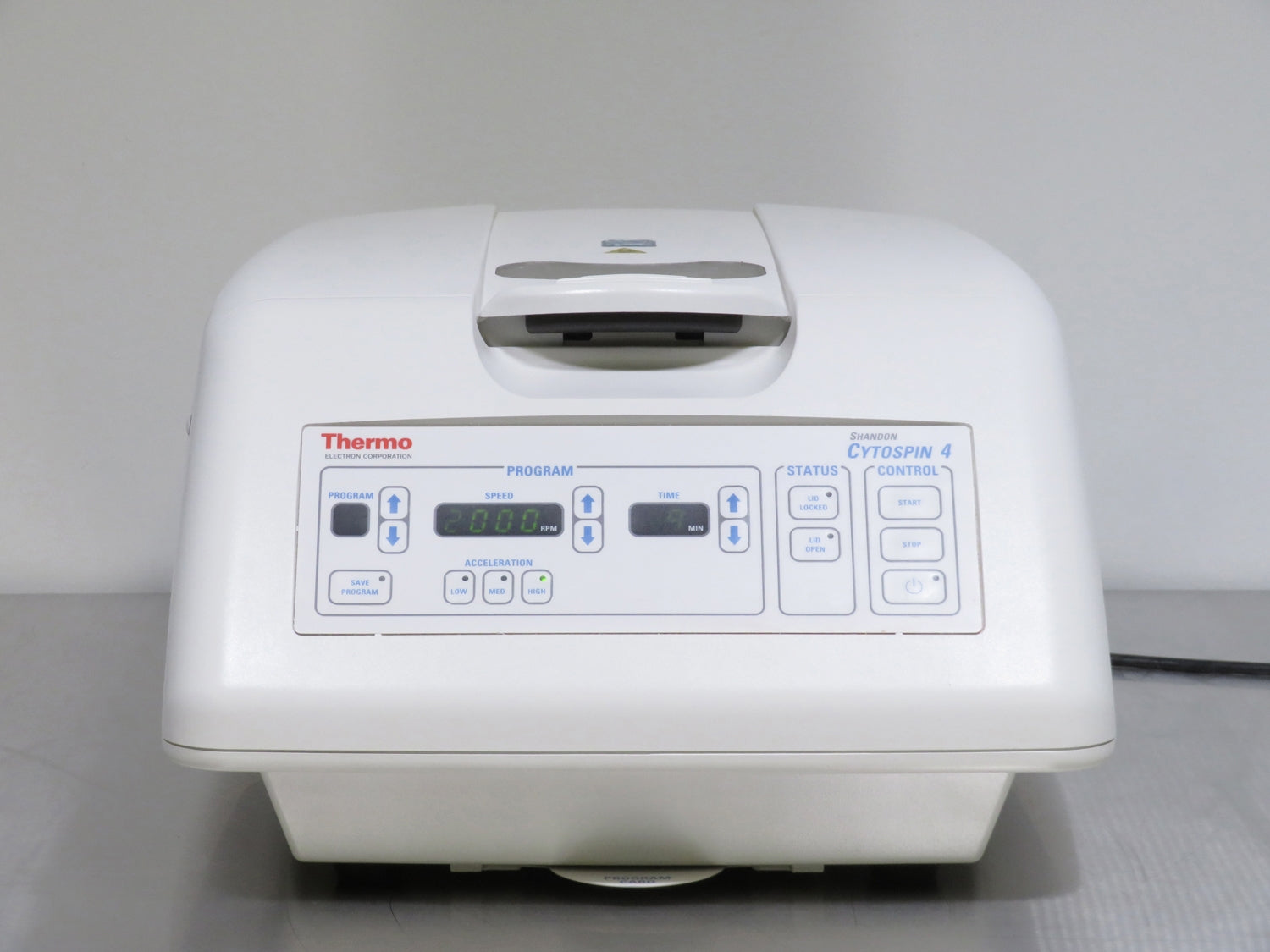


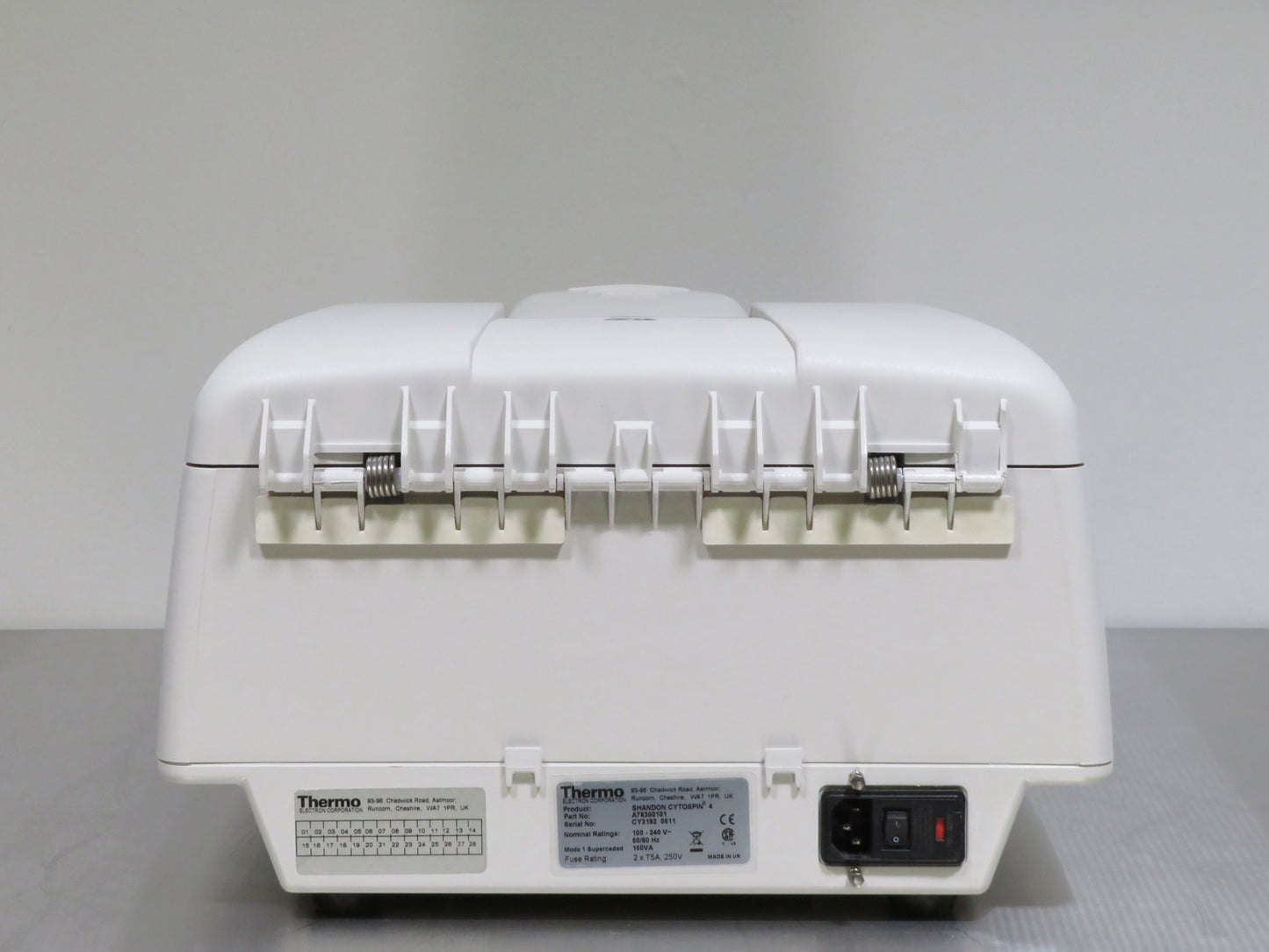
Thermo Scientific Cytospin 4 Centrifuge
Speed Range
200 to 2,000 RPM
Capacity
Up to 12 Specimens at Once
Weight
26.5 lb. (12 kg)
- Processes 12 specimens simultaneously for efficient sample preparation
- Lid-release allows one-handed operation with secure locking
- Polycarbonate window provides clear view of samples during operation
- Safety features prevent fluid spills and meet IEC 61010 standards
- Program memory stores up to 23 routines for quick recall
- User-friendly keypad and display for easy speed and time adjustments
- Specimen alarms prevent air-drying with regular interval reminders
- Audible alerts signal imbalances, speed issues, or unlocked lids

The Thermo Scientific Cytospin 4 Centrifuge is a low speed centrifuge used
to separate and deposit a monolayer of cells on slides while maintaining
cellular integrity. The Thermo Scientific Cytospin 4 Centrifuge deposits cells onto a clearly defined area of a glass slide and allows the residual fluid into the sample chamber's filter card.The Cytospin 4 processes 12 specimens at one time and accepts all protocols from previous models (Cytospin 1, 2, and 3). The redesigned lid-release allows for one handed opening and closing for easy access of the outer lid. The Thermo Scientific Cytospin 4 Centrifuge offers a speed range of between 200 and 2000 RPM and protected program memory stores up to 23 routines for instant recall and protects from power loss.
The Thermo Scientific Cytospin 4 Centrifuge is most commonly used in life
science applications for hematology, cytology, histology, oncology,
rheumatology, immunochemistry, microbiology, serology, and virology.
All of our equipment is fully tested to perform at factory
specifications before being shipped.
The Thermo Scientific Cytospin 4 Centrifuge includes:
- > Cytospin Rotor
- > 12 Cytoclips
- > NIST Centrifuge Calibration and Preventative Maintenance Report
- > Operator's Guide
- > Power Cord
- > Full 180 Day Parts and Labor Warranty
Thermo Scientific Cytospin 4 Centrifuge Specifications
| Speed Range | 200 to 2,000 RPM |
| Maximum Capacity | Up to 12 Specimens at Once |
| Program Memory | 9 programmable memory banks |
| Timer | 1 to 99 minutes |
| Overall Dimensions (H x W x D) | 9.5 x 16 x 24.5 in. (24 x 40.5 x 62 cm) |
| Weight | 26.5 lb. (12 kg) |
| Electrical Requirements | 100 to 240V 50/60Hz |
- Confirm the power supply output voltages match specified requirements for stable distribution to all internal components
- Measure and verify voltages at PCB test points to ensure accurate power delivery and circuit integrity
- Confirm rotor compatibility with the centrifuge model and check that rotor detection systems recognize the rotor type
- Inspect the exterior for any cosmetic or structural damage that could affect performance or safety
- Check the door mechanism alignment to ensure secure and smooth opening and closing
- Inspect and replace the gas strut with an OEM part to maintain proper door support and safety
- Examine the rotor chamber bowl for dents or damage and replace as needed to ensure safe operation
- Replace and confirm full functionality of all lid lock switches to maintain secure closure
- Inspect and lubricate the door lock mechanism, applying grease to the lid lock rail for smooth operation
- Test compressor functionality (if applicable) to ensure proper operation and consistent temperature control
- Conduct an 8-12 hour cycle test to validate consistent performance over prolonged use
- Confirm rotor motor stability, check for unusual noise, and assess mechanical integrity during operation
- Inspect the condensation drain and clear any clogs to prevent moisture buildup in the rotor chamber
- Verify RPM accuracy using an NIST-traceable tachometer and perform calibration as necessary
- Check the centrifuge error log to ensure zero recorded issues, confirming system reliability
Technician Inspection and Recertification Checklist: Centrifuges
The Following Checklist Is to Be Performed on All Incoming and Outgoing Pieces of Equipment| Task | Completed? | Remarks? |
| Confirm power supply output voltages match specified requirements | Completed | |
| Measure and verify voltages at PCB test points for accuracy | Completed | |
| Confirm rotor compatibility and detection for proper identification | Completed | |
| Inspect exterior for cosmetic or structural damage | Completed | |
| Check door mechanism alignment for secure opening and closing | Completed | |
| Inspect and replace gas strut with OEM part as needed | Completed | |
| Examine rotor chamber for dents or damage and replace if necessary | Completed | |
| Replace and confirm functionality of all lid lock switches | Completed | |
| Lubricate door lock mechanism and lid lock rail for smooth operation | Completed | |
| Test compressor (if applicable) for proper operation and cooling | Completed | |
| Run 8-12 hour cycle test to ensure consistent performance | Completed | |
| Check rotor motor for stability, noise, and integrity | Completed | |
| Inspect and clear condensation drain to prevent buildup | Completed | |
| Verify RPM accuracy with NIST traceable tachometer and calibrate | Completed | |
| Check centrifuge error log for zero recorded issues | Completed |
102 Tide Mill Road, Hampton NH 03842
customerservice@marshallscientific.com | (603) 601-8511 |
www.marshallscientific.com
Copyright © 2024 by Marshall Scientific LLC. All rights reserved.

Downloads
 Click Here to View the Technical Specs for the Cytospin 4


